Pressure meets pressure.
Each state puts in effort in proportion to its stake and to its rivals' effort. The engine solves the equilibrium every time a stake moves.
The equilibrium
x* = (I − λG)⁻¹ a.
The interior Nash equilibrium of Ballester, Calvó-Armengol and Zenou (2006). G is the rivalry relations, a the live stakes, λ the complementarity, which is required and never defaulted.
Efforts, day by day.
scripts/sites/case-studies.mjs hormuz stepped the shipped world at escalation 1.8 and complementarity 0.3.
day   0  Iran 0.39  United States 0.97  Saudi Arabia 0.57  closure  0.0%
day  20  Iran 2.37  United States 1.65  Saudi Arabia 0.94  closure 30.5%
day  40  Iran 2.59  United States 2.02  Saudi Arabia 1.05  closure 43.7%
day  70  Iran 2.61  United States 2.05  Saudi Arabia 1.06  closure 44.2%
day  90  Iran 1.20  United States 1.36  Saudi Arabia 0.75  closure  0.0%
day 120  Iran 0.39  United States 0.97  Saudi Arabia 0.57  closure  0.0%
The equilibrium over time
The United States doubles its effort.
From 0.97 to 2.05 at the height, because the price raises its stake (case-studies/hormuz/stats.json).
Refused when it diverges. A game with λ·ρ(G) ≥ 1 has no interior equilibrium. The engine stops the run and says why. Coupled by equations. There is no bus. A game reads each entity's stake, and each entity writes its stake from what it sees. Declared payoffs. The equilibrium is of the payoffs the file declares. It is structural, not a forecast of what states will do.
- Iran's effort, day 0 to day 70
- 0.39 → 2.61
- the United States' effort
- 0.97 → 2.05
- the strait's closure at the height
- 44.2%
Simulated
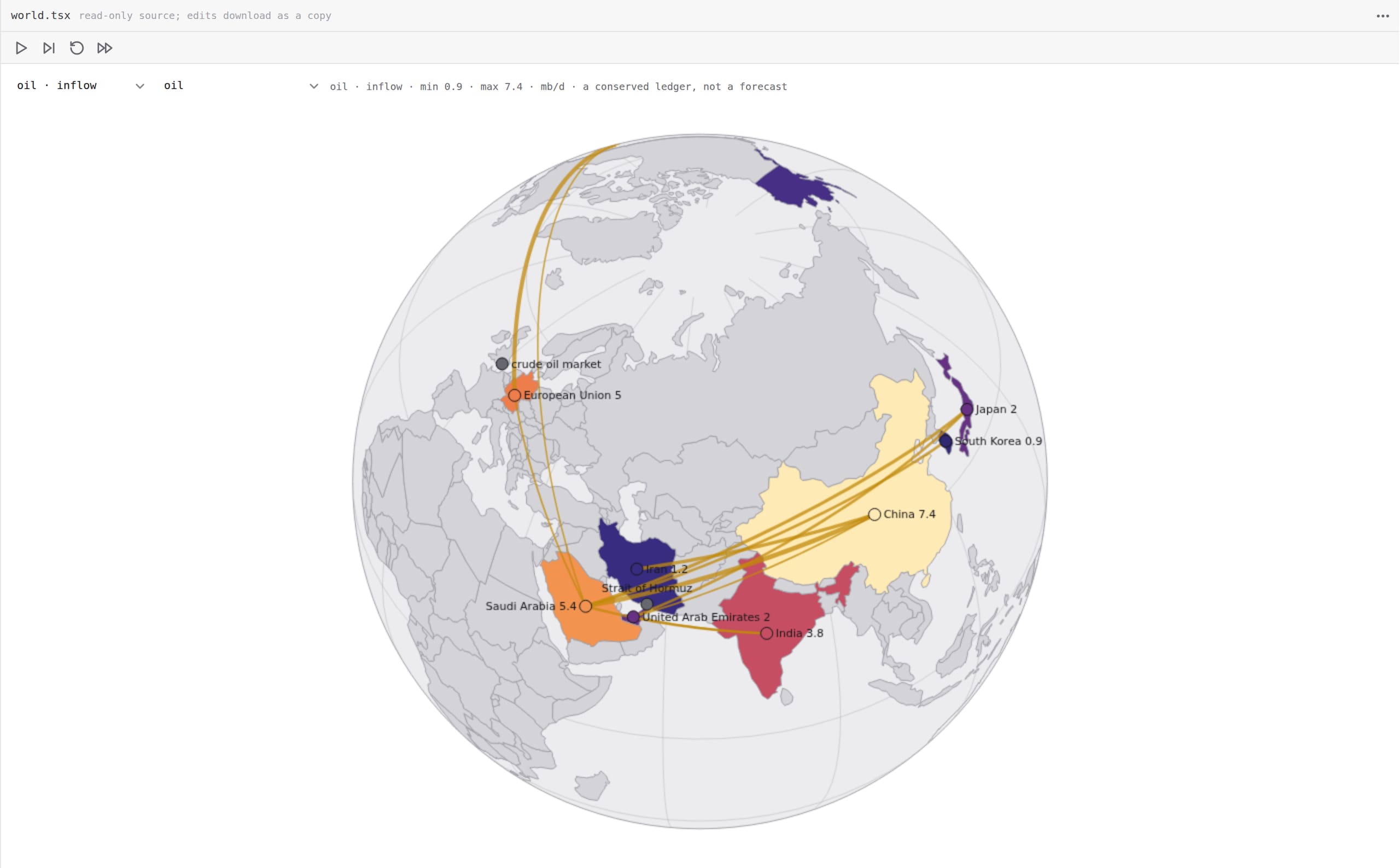
In the geo-hormuz simulation at escalation 1.8, Iran's effort rises from 0.39 to 2.61 by day 70 and the United States' from 0.97 to 2.05, then both fall back by day 120. A run of the world's declared oil numbers (case-studies/hormuz/stats.json).
数値
| Day | Iran | United States | Saudi Arabia |
|---|---|---|---|
| 0 | 0.39 | 0.97 | 0.57 |
| 10 | 1.32 | 1.26 | 0.74 |
| 20 | 2.37 | 1.65 | 0.94 |
| 30 | 2.56 | 1.93 | 1.03 |
| 40 | 2.59 | 2.02 | 1.05 |
| 50 | 2.6 | 2.04 | 1.06 |
| 60 | 2.61 | 2.05 | 1.06 |
| 70 | 2.61 | 2.05 | 1.06 |
| 80 | 1.97 | 1.81 | 0.94 |
| 90 | 1.2 | 1.36 | 0.75 |
| 100 | 0.47 | 1.02 | 0.59 |
| 110 | 0.4 | 0.98 | 0.57 |
| 120 | 0.39 | 0.97 | 0.57 |
cloud://global/examples/simulations/geo-hormuz/geo-hormuz.3d.tsxOutput case-studies/hormuz/stats.jsonTool scripts/sites/case-studies.mjs hormuz: sim-engine.jsRan on This computer (dell-gb10-1)When Change λ. Find the tipping point.
Complementarity runs from 0 to 0.6 in the world's parameters.