Pull one lever, see what moves.
An intervention is a parameter of a run. Set it, run the world, and compare the run with the one before it, line by line.
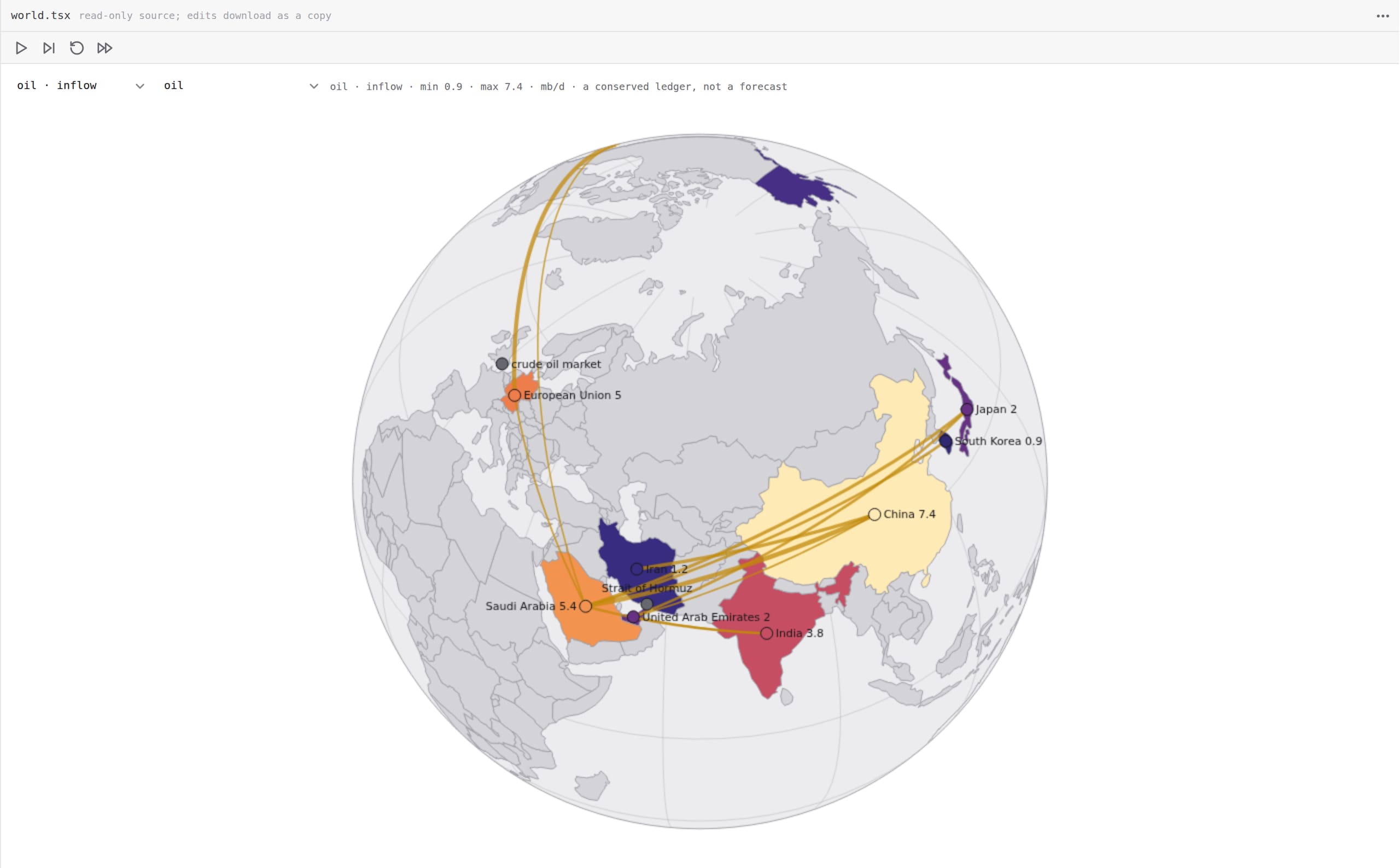

A lever
The lever is in the file.
A world declares its parameters with their bounds. A run records the values it ran with, so an intervention is never a hidden edit.
The run names its lever.
scripts/sites/case-studies.mjs hormuz recorded the world's base case and kept its run.json in that file. It names the values it ran with, and the year and files of BEA's tables it read. Any run you make records yours the same way.
{
  "of": "cloud://global/examples/simulations/geo-hormuz/geo-hormuz.3d.tsx",
  "reality": "simulation",
  "title": "geo-hormuz: 120 days at its own parameters",
  "simulator": {
    "driver": "sim",
    "settings": {
      "hz": 1, "record_hz": 1,
      "table.io.period": "2025", "table.io.level": "summary",
      "table.io.use": "cloud://home/user-commandagi/flows/input-output/bea-use.csv",
      "table.io.use.sha256": "6d300df97dd023ba47aeffc97e7136a837be4aeba54cf0a877e4099aa5b93c12",
      "table.io.make": "cloud://home/user-commandagi/flows/input-output/bea-make.csv",
      "table.io.make.sha256": "9b397f8b96fbc45360d177d1257b0ede8a27f6e1456a37d0bd6af70cdf94515c",
      "param.escalation": 1.8, "param.sa_exposure": 0.6, "param.complementarity": 0.3
    }
  }
}
Three interventions
Escalation 1.2, 1.8, 2.4: the price follows.
The one engine stepped the world three times with only escalation changed (case-studies/hormuz/stats.json).
Recorded before it runs. A command a principal gives a running simulation is recorded before the engine gets it, then the step it took effect at. Fork, then change. Fork a run at a moment and set a lever from there. The fork names the run it came from. Honest about the model. The oil ledger's rates, the game's stakes and the price rule are declared round numbers of the right order, not measurements. The input–output side is BEA's 2025 tables. The world's description says which is which.
- peak at escalation 1.2
- $90.5
- peak at 1.8
- $117.3
- peak at 2.4
- $144.1
Simulated
In the geo-hormuz simulation the oil price peaks at $90.5 with escalation 1.2, $117.2 with 1.8 and $144.0 with 2.4, all around day 70, and returns to about $80 by day 120. A run of the world's declared oil numbers (case-studies/hormuz/stats.json).
Os números
| Day | Escalation 1.2 | Escalation 1.8 | Escalation 2.4 |
|---|---|---|---|
| 0 | 80 | 80 | 80 |
| 10 | 80 | 80 | 80 |
| 20 | 80 | 87 | 98 |
| 30 | 87 | 108 | 130 |
| 40 | 89.5 | 115 | 140 |
| 50 | 90.2 | 117 | 143 |
| 60 | 90.4 | 117 | 144 |
| 70 | 90.5 | 117 | 144 |
| 80 | 86.6 | 112 | 136 |
| 90 | 81.3 | 91.5 | 109 |
| 100 | 80.3 | 82.3 | 86.3 |
| 110 | 80.1 | 80.4 | 81.2 |
| 120 | 80 | 80.1 | 80.2 |
cloud://global/examples/simulations/geo-hormuz/geo-hormuz.3d.tsxOutput case-studies/hormuz/stats.jsonTool scripts/sites/case-studies.mjs hormuz: sim-engine.jsRan on This computer (dell-gb10-1)When Try your own intervention.
Open the world and set its parameters.