A folder becomes a website.
Put a site.json in a folder and it has an address. Each deploy is a record in the folder, a preview before production, and a domain of your own when you add one.
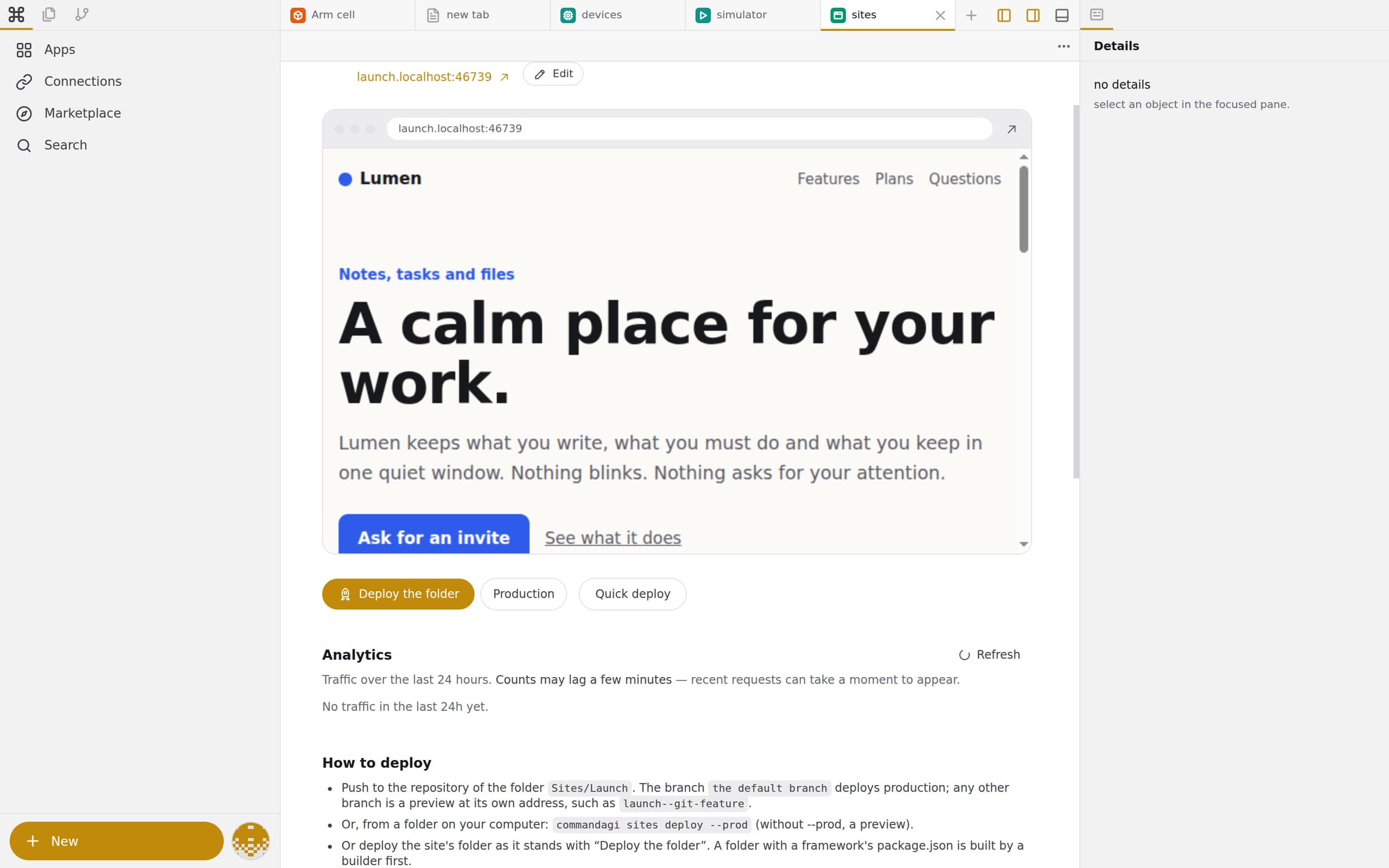
From a folder to an address
A site is a folder with a site.json.
Only the slug is required. The build is detected or named, each deploy writes its record and its log into the folder, and the slug is a claim: two folders cannot publish at one address.
One real site, as stored.
Worldline's opt-out page: the one-click link at the end of every outreach mail. Its site.json in CommandAGI's Drive, as it is.
{
  "v": 1,
  "slug": "worldline-optout",
  "description": "Worldline's opt-out page: the one-click link at the end of every outreach mail, and the list every sender honours.",
  "status": "active",
  "resources": [],
  "domains": []
}
What is live today
One site claimed, none deployed yet.
The platform's answer for CommandAGI's own account on 2026-11-04: one site, worldline-optout, claimed on 2026-10-28 and private. It has no deploy yet and no domain of its own. Seven company folders hold a sites/BRIEF.md: the brief of a site that lives on that company's own organisation Drive, which this study does not read. The hosting itself is verified on the local platform (docs/site-hosting.md): push, preview, rollback and five frameworks.
- site claimed by CommandAGI's account
- 1
- deploys, 0 custom domains
- 0
- templates to start from: blog, docs, landing, portfolio, shop, status
- 6
- site briefs in company folders
- 7
GET /v1/sites (production)输出 case-studies/sites-and-domains/stats.json工具 scripts/sites/case-studies.mjs sites-and-domains运行于 This computer (dell-gb10-1), as user-commandagi时间 Make your folder a site.
Start from a template, or point a folder you have at a slug.