Write the limits. Get the part that meets them.
A study file names the part, its material, its fixtures, its loads and its criteria. The planner meshes it, solves it, and changes the part until it passes.
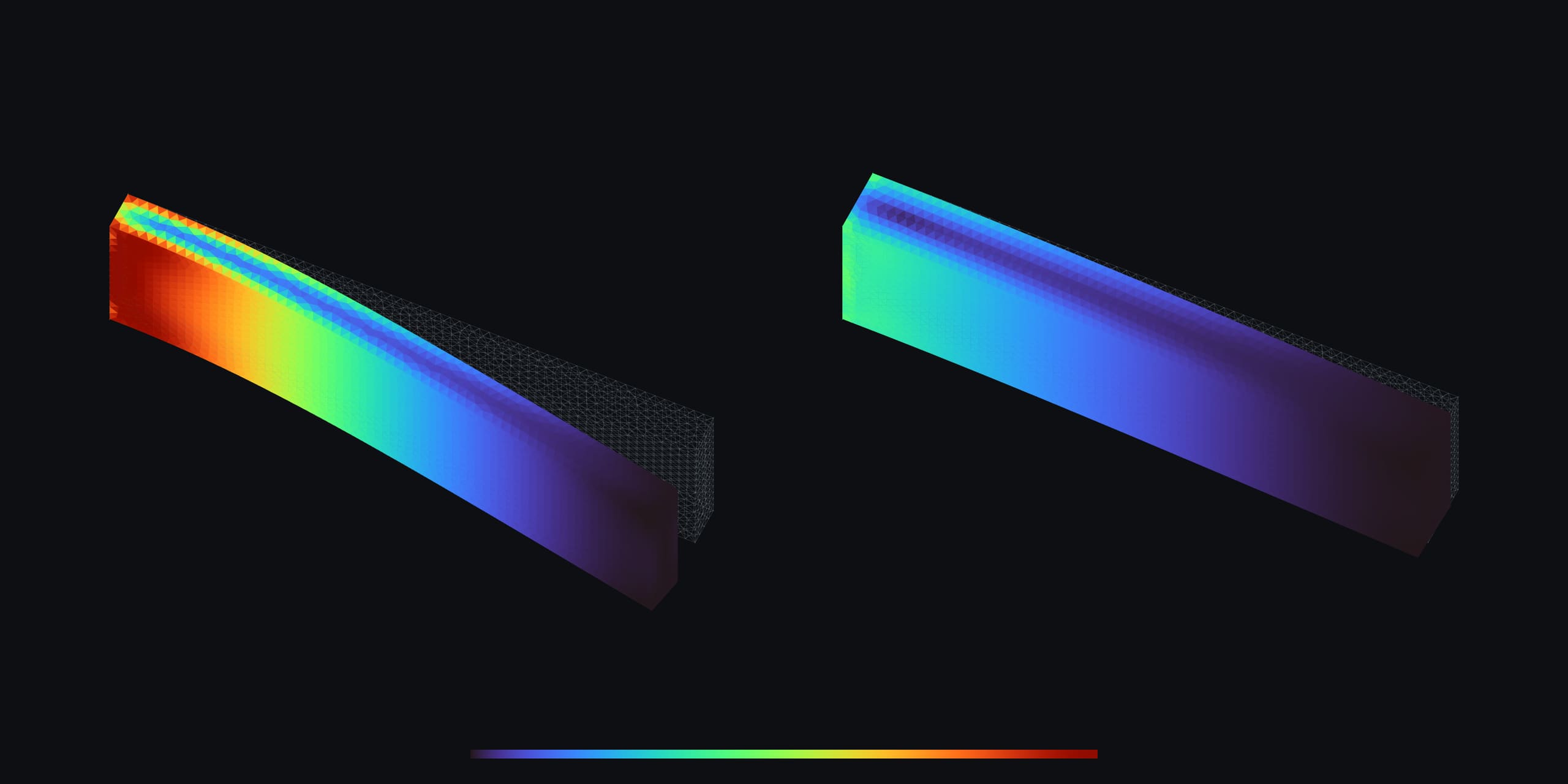
Case study · a gripper jaw
At 4 mm the jaw bends 8.7 mm.
One jaw of a parallel gripper: PETG, 60 mm long, held at its root by the carriage, with 40 N of grip spread over its face. The study asks for at most 2 mm of deflection and at most half of PETG's yield. The first sweep, three meshes from 2 mm to 1 mm, fails both.
- deflection at the tip (the limit is 2 mm)
- 8.72 mm
- von Mises stress (the limit is 23 MPa)
- 25.5 MPa
- mesh levels, quadratic tetrahedra
- 3
- GCI of the deflection across the levels
- 1.42%
Simulated
cloud://home/user-commandagi/case-studies/fea-studies/gripper-jaw/Jaw.study.tsxRun runs/20261104t163537z-2ireTool commandagi validate --run --reviseRan on This computer (dell-gb10-1): the fea kernel in its container; the part built by the 3D service on AWS LambdaWhen The planner
Seven tries to the thinnest jaw that passes.
The study lets the planner change one parameter, the jaw's thickness, from 3 to 12 mm. It tries the strong end, then halves the gap between a pass and a fail. Each try is a sweep of three solves, on the record. It stops at 6.625 mm, 0.125 mm above the last fail, and writes the new thickness into Jaw.3d.tsx.
cloud://home/user-commandagi/case-studies/fea-studies/gripper-jaw/Jaw.study.tsxRun runs/20261104t163651z-0r0jTool commandagi validate --run --reviseWhen The result
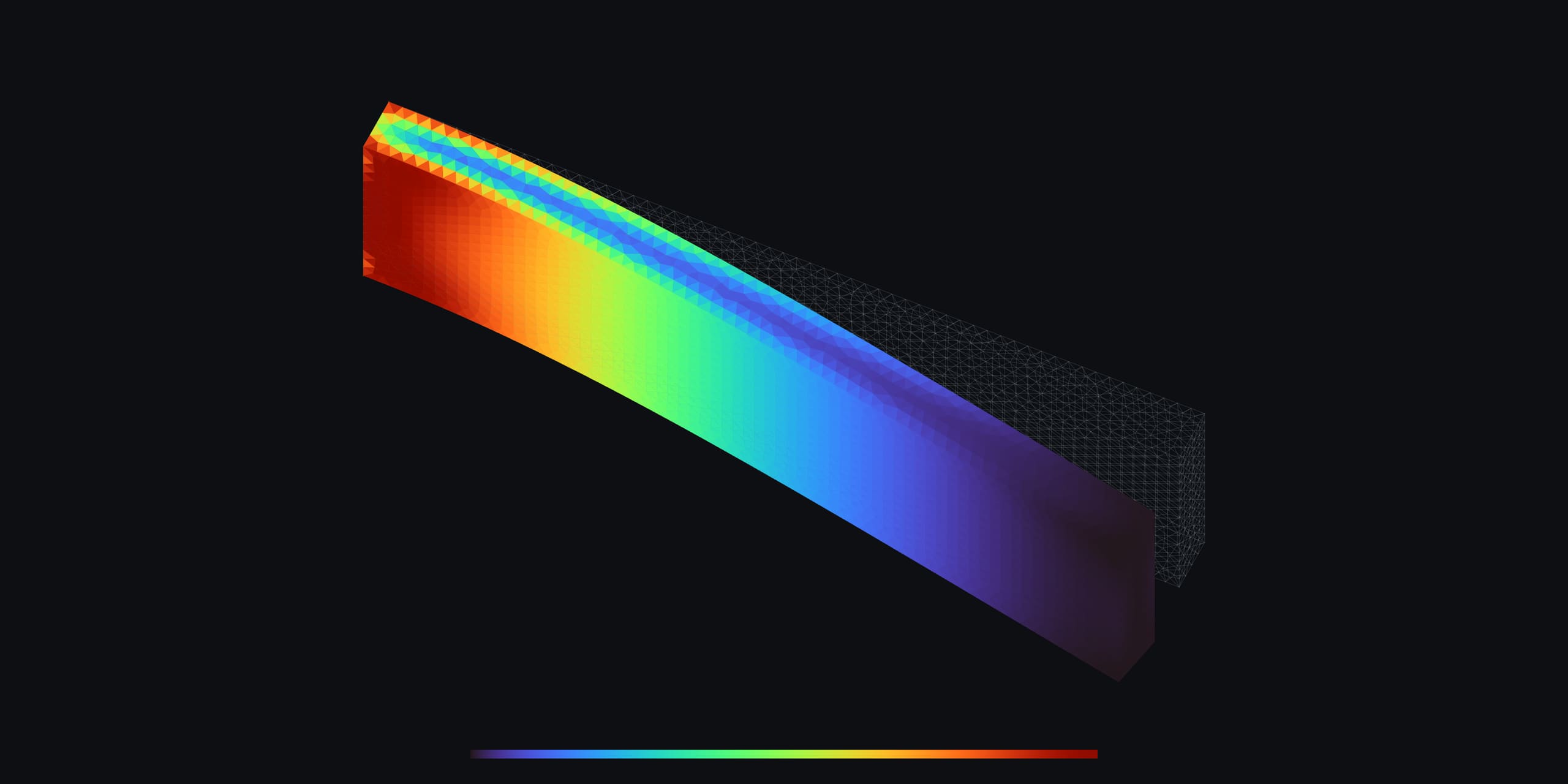
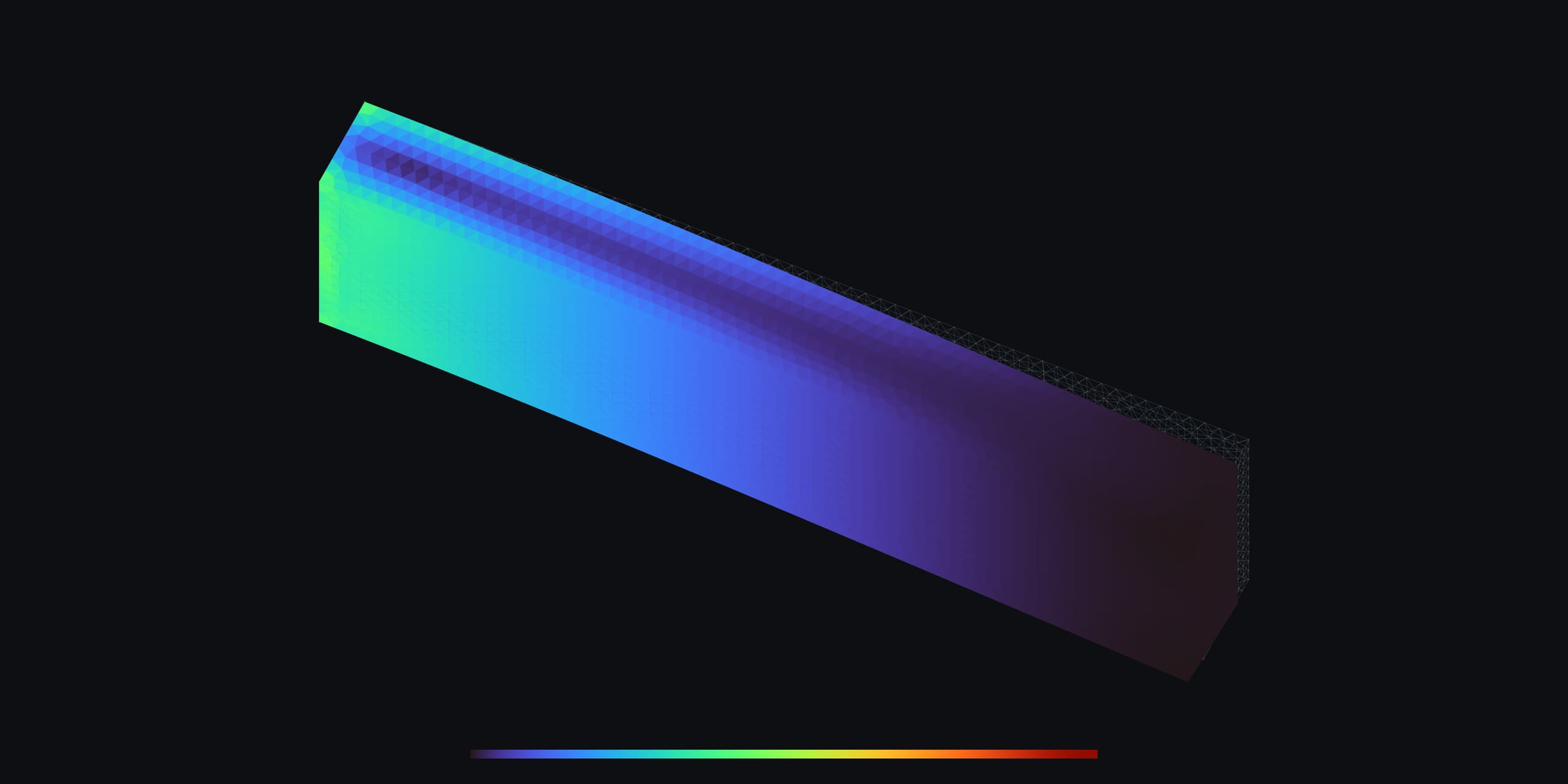
At 6.625 mm, every check passes.
The last sweep holds: deflection and stress are under their limits, and the checks that make a result worth reading pass too. The reactions balance the load, the residual is small, the mesh converges, and the stress peak at the clamp's edge is named as a number of the mesh, not of the part. Beam theory for the same cantilever gives about 1.98 mm, so the solve agrees with the textbook to 2%.
- deflection at the tip
- 1.95 mm
- von Mises stress, 40% of the limit
- 9.25 MPa
- nodes on the finest mesh, solved in 5.8 s
- 44,910
- GCI of the deflection
- 0.42%
- solves in 8 sweeps, in 84 s
- 24
- of the load left unbalanced
- 1.1 × 10⁻⁶
Simulated
cloud://home/user-commandagi/case-studies/fea-studies/gripper-jaw/Jaw.study.tsxRun runs/20261104t163651z-0r0jTool the fea kernel: Gmsh and CalculiXRan on This computer (dell-gb10-1)When Study your own part.
A study is one file beside the part. Write it, or ask an agent to, and let the planner find the part that holds.