An assembly, in one file.
A .3d.tsx declares the bodies, the features and the mates. The 3D editor opens it with its usual tools and writes each edit back into the code.
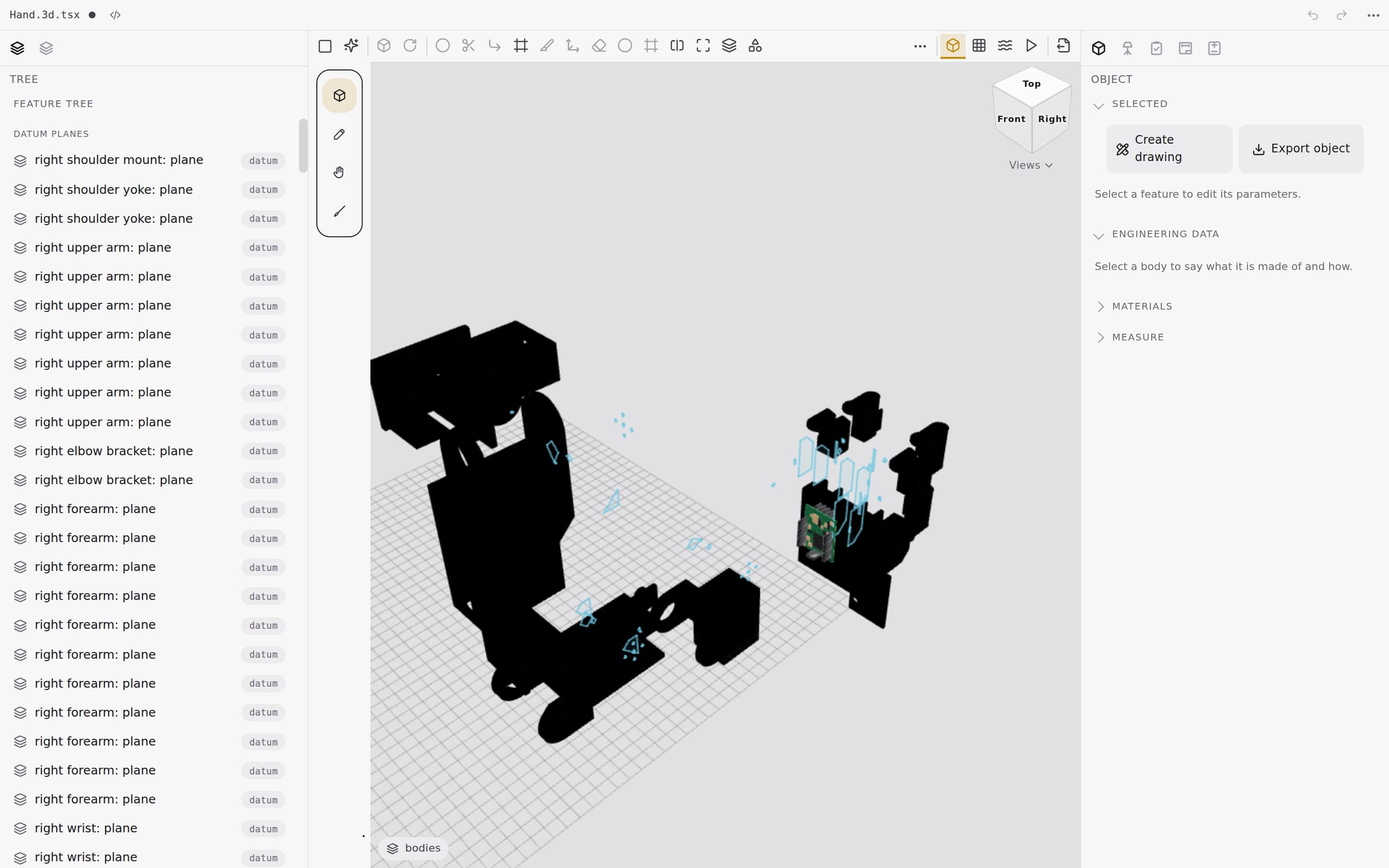
One assembly, as stored
Seven bodies and five mates, in 22 lines.
The two-lobe pump that the arm builds on assembly. Its joints are the assembly's mates: two shafts turn in their bearings, each rotor is keyed to its shaft, and the cap is bolted on. The world beside it holds the same mates as constraints. Three of its lines:
<cylinder id="pump/drive-rotor" name="pump/drive-rotor" center={[76, -70, 790]} axis={[0, 0, 1]} radius={12.5} height={16} operation="new" />
<joint id="pump/drive-bearing" kind="revolute" a="pump/housing" b="pump/drive-shaft" anchor={[76, -70, 776]} axis={[0, 0, 1]} />
<joint id="pump/drive-rotor-key" kind="fixed" a="pump/drive-shaft" b="pump/drive-rotor" anchor={[76, -70, 782]} />
Case study · the products we make
46 parts and assemblies, 8,351 lines of code.
Every product we design is a folder of hardware/, and its CAD is .3d.tsx files: the parts, the printed sets and the assemblies that import them by relative path.
This study only counts the files. What the 3D design service computes from them, the manufacturing findings and the drawing sheets, is on DFM and drawings, from two of these parts.
.3d.tsxfiles in 13 product folders- 46
- lines in all
- 8,351
cloud://home/user-commandagi/hardware/输出 case-studies/3d-cad/stats.json工具 scripts/sites/case-studies.mjs 3d-cad运行于 This computer (dell-gb10-1)时间 Write the part. Or drag it.
Edit the code, or use the editor's sketch, extrude and fillet tools: both change the same file.