Pressure meets pressure.
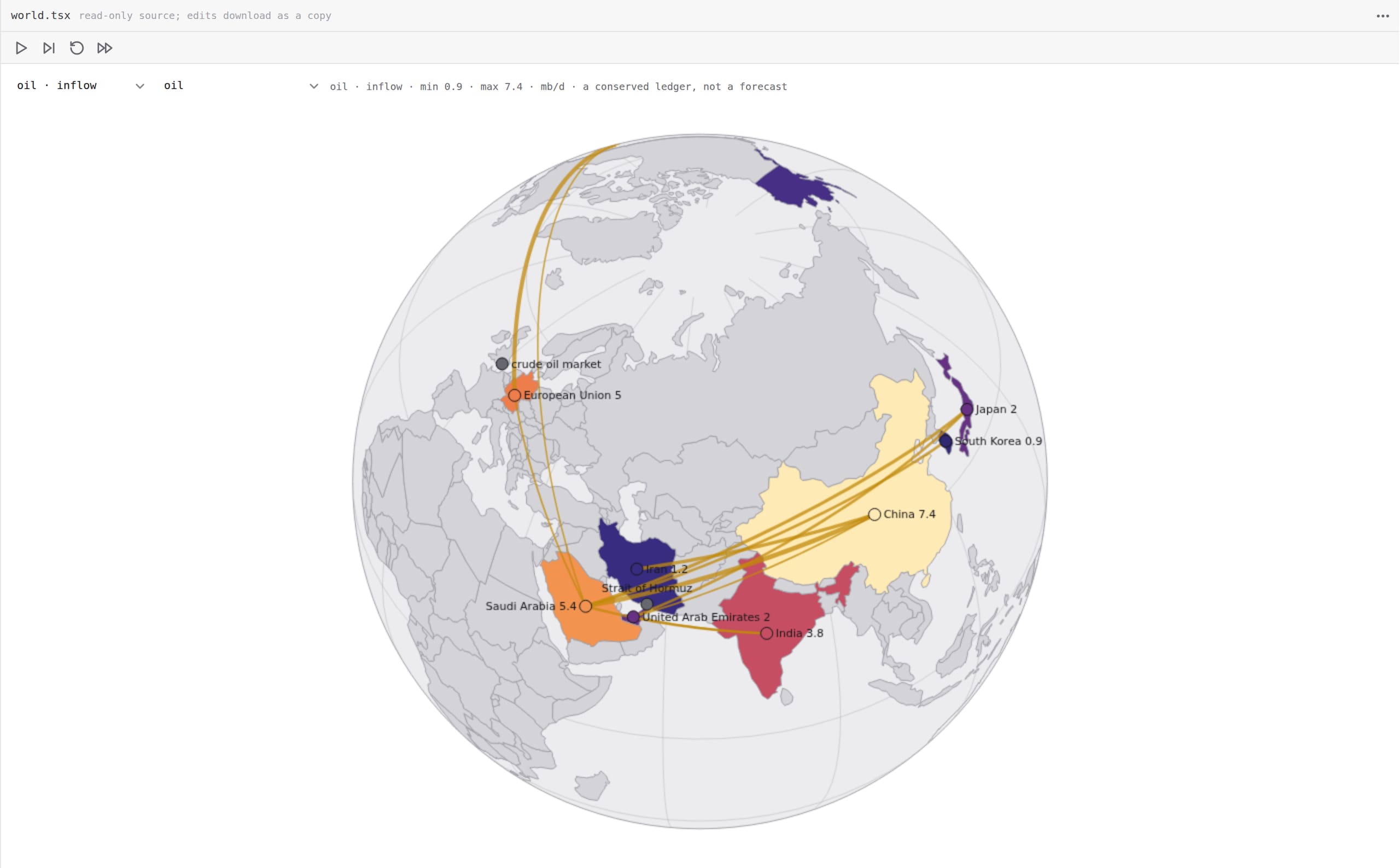
Each state puts in effort in proportion to its stake and to its rivals' effort. The engine solves the equilibrium every time a stake moves.
The equilibrium
x* = (I − λG)⁻¹ a.
The interior Nash equilibrium of Ballester, Calvó-Armengol and Zenou (2006). G is the rivalry relations, a the live stakes, λ the complementarity, which is required and never defaulted.
Efforts, day by day.
scripts/sites/case-studies.mjs hormuz stepped the shipped world at escalation 1.8 and complementarity 0.3.
day   0  Iran 0.39  United States 0.97  Saudi Arabia 0.57  closure  0.0%
day  20  Iran 2.37  United States 1.65  Saudi Arabia 0.94  closure 30.5%
day  40  Iran 2.59  United States 2.02  Saudi Arabia 1.05  closure 43.7%
day  70  Iran 2.61  United States 2.05  Saudi Arabia 1.06  closure 44.2%
day  90  Iran 1.20  United States 1.36  Saudi Arabia 0.75  closure  0.0%
day 120  Iran 0.39  United States 0.97  Saudi Arabia 0.57  closure  0.0%
The equilibrium over time
The United States doubles its effort.
From 0.97 to 2.05 at the height, because the price raises its stake (case-studies/hormuz/stats.json).
Refused when it diverges. A game with λ·ρ(G) ≥ 1 has no interior equilibrium. The engine stops the run and says why. Coupled by equations. There is no bus. A game reads each entity's stake, and each entity writes its stake from what it sees. Declared payoffs. The equilibrium is of the payoffs the file declares. It is structural, not a forecast of what states will do.
- Iran's effort, day 0 to day 70
- 0.39 → 2.61
- the United States' effort
- 0.97 → 2.05
- the strait's closure at the height
- 44.2%
Simulated
In the geo-hormuz simulation at escalation 1.8, Iran's effort rises from 0.39 to 2.61 by day 70 and the United States' from 0.97 to 2.05, then both fall back by day 120. Illustrative numbers, not data.
The numbers
| Day | Iran | United States | Saudi Arabia |
|---|---|---|---|
| 0 | 0.39 | 0.97 | 0.57 |
| 10 | 1.32 | 1.26 | 0.74 |
| 20 | 2.37 | 1.65 | 0.94 |
| 30 | 2.56 | 1.93 | 1.03 |
| 40 | 2.59 | 2.02 | 1.05 |
| 50 | 2.6 | 2.04 | 1.06 |
| 60 | 2.61 | 2.05 | 1.06 |
| 70 | 2.61 | 2.05 | 1.06 |
| 80 | 1.97 | 1.81 | 0.94 |
| 90 | 1.2 | 1.36 | 0.75 |
| 100 | 0.47 | 1.02 | 0.59 |
| 110 | 0.4 | 0.98 | 0.57 |
| 120 | 0.39 | 0.97 | 0.57 |
cloud://global/examples/template-library/worlds/geo-hormuz/world.tsxOutput case-studies/hormuz/stats.jsonTool scripts/sites/case-studies.mjs hormuz: sim-engine.jsRan on This computer (dell-gb10-1)When Change λ. Find the tipping point.
Complementarity runs from 0 to 0.6 in the world's parameters.