The job, before the printer.
Each printer is a unit of a world. Before a program reaches one, the driver's gate holds it to the printer's build volume, and the twin plays it through.
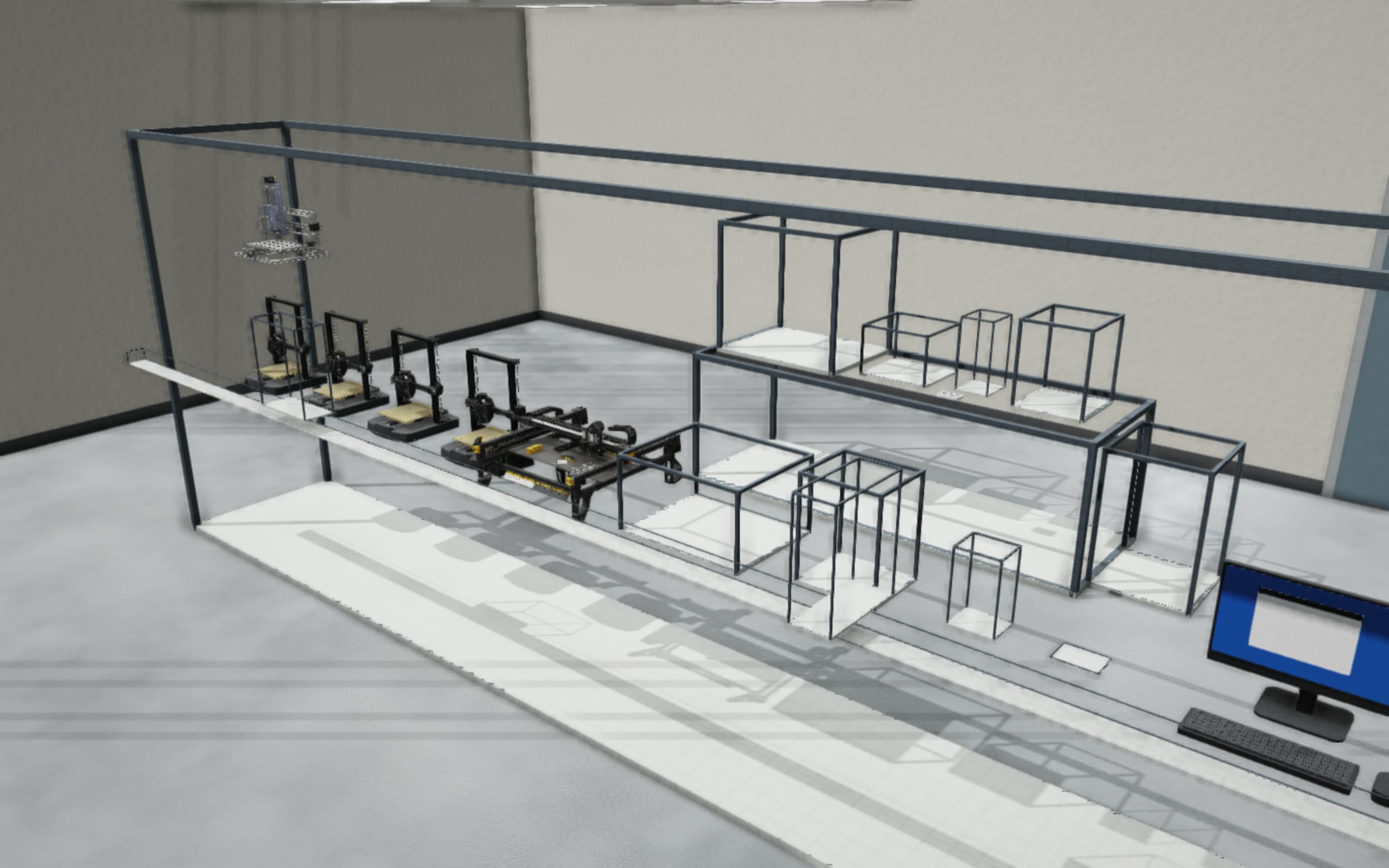
Case study · Cam-002's plate on the fleet
Admitted on all 12 printers, reaching none of them.
The program is the slicing case study's G-code for Cam-002's printed parts. Each of the 12 printers in CommandAGI's shop is a unit of worlds/fleet/world.tsx. The gate read each unit's channel from the Ender-3 V3 SE's definition and held the program to the build volume it declares.
Simulated
- printers admit the program
- 12 of 12
- build volume each one holds it to
- 220 × 220 × 250 mm
- the program spans
- 141 × 220 × 41 mm
- printers reached: this is a simulation
- 0
cloud://home/user-commandagi/case-studies/printer-runs/cam-002-plate-on-the-fleet.call.jsonRun runs/20261104t163358z-cam-002-plate-on-the-fleetTool admission.js, the driver's gate; twin.js, the twin's timelineRan on This computer (dell-gb10-1)When What the twin plays
2 h 24 min of moves, 3 h 50 min of printing.
The twin times each move at its commanded feed, and each travel at 3,000 mm/min because the definition names no travel rate. It has no acceleration, so its time is a lower bound. The slicer's estimate, 3 h 50 min, is the nearer one.
- of extruding moves, 227,372 of them
- 576.6 m
- of travel, 25,018 moves
- 96.8 m
- layers
- 154
- of the 12 printers commissioned
- 0
Simulated
cloud://home/user-commandagi/case-studies/printer-runs/cam-002-plate-on-the-fleet.call.jsonRun runs/20261104t163358z-cam-002-plate-on-the-fleetTool twin.js programTimelineWhen Run a job in simulation first.
The same program, the same gate and the same records run on a physical printer once it is commissioned and someone holds a grant for it.